Been told you have a “tear” in your rotator cuff? This can be a pretty alarming thing to hear after getting your ultrasound or MRI results back. All sorts of thoughts can run through your mind: Will I need surgery? Is exercise safe? Can it even be fixed? These are all valid questions we hear in clinic all the time.
However, we now know through research that structural changes to a tendon — things like tendinosis or tears — are incredibly common as we get older, and turn up just as often in people with zero symptoms. Research shows rotator cuff tear rates as high as 80% in people over the age of 80 (Geary & Elfar, 2015).
So what does this actually mean?
First, let’s unpack the role of the rotator cuff and how it works, then we’ll get into treatment options.
Anatomy and function of the rotator cuff
The rotator cuff is made up of four muscles that run from your shoulder blade to your humeral head (top of your upper arm bone). Our shoulder is a ball-and-socket joint that’s incredibly mobile but inherently unstable — some people describe it as a golf ball sitting on a tee. That mobility is great for moving your arm in every direction, but it makes the joint far less stable than other ball-and-socket joints in the body, like the hip, which sits in a much deeper socket.
The rotator cuff acts as a “dynamic stabiliser” — it holds the ball of the shoulder centred in the socket while the bigger, more powerful muscles do the heavy lifting: pushing, pulling, lifting overhead.
As a result, the rotator cuff copes with a huge amount of load relative to its size — which is a big part of why it’s so prone to wear and tear over time.
Common questions from patients diagnosed with a rotator cuff tear
Do I need imaging?
Imaging is the only way to confirm a rotator cuff tear with certainty. But even when a tear shows up on a scan, that doesn’t automatically mean you need treatment for it — if your shoulder’s general function (range of movement and strength) has been maintained, the scan may not change your management at all. Imaging is generally reserved for people with clinical red flags — for example a traumatic injury, significant weakness, or symptoms that aren’t improving with a proper trial of rehab.
I have a rotator cuff tear — what’s the best treatment?
There’s no single “best” treatment for a rotator cuff tear — it depends on the tear and the person.
If a serious, full-thickness tear is detected — particularly after trauma or with significant loss of strength — an orthopaedic/surgical opinion should always be sought early, so surgery stays on the table as an option if needed.
Beyond that, it comes down to a few factors:
- Traumatic vs gradual onset – gradual-onset tears are common with chronic shoulder tendon issues and generally don’t require surgery.
- Size of the tear – partial-thickness tears can usually be trialled with non-surgical management first. Full-thickness tears are more likely to need a surgical opinion, especially with significant weakness or functional loss.
- Your age – a younger person with a large tear and loss of function will most likely need an orthopaedic opinion and possibly surgery, whereas an older person is more likely to do well trialling conservative options first.
- Your goals, sport, or work demands – athletes or workers with high physical demands may have a lower threshold for surgery, since they need full strength back sooner.
Will a cortisone injection help?
Cortisone isn’t recommended as a first-line treatment. If pain is genuinely limiting your ability to do rehab and progress has stalled after a proper trial (generally around 3 months), it can be considered at that point.
Is it safe to strengthen a tear?
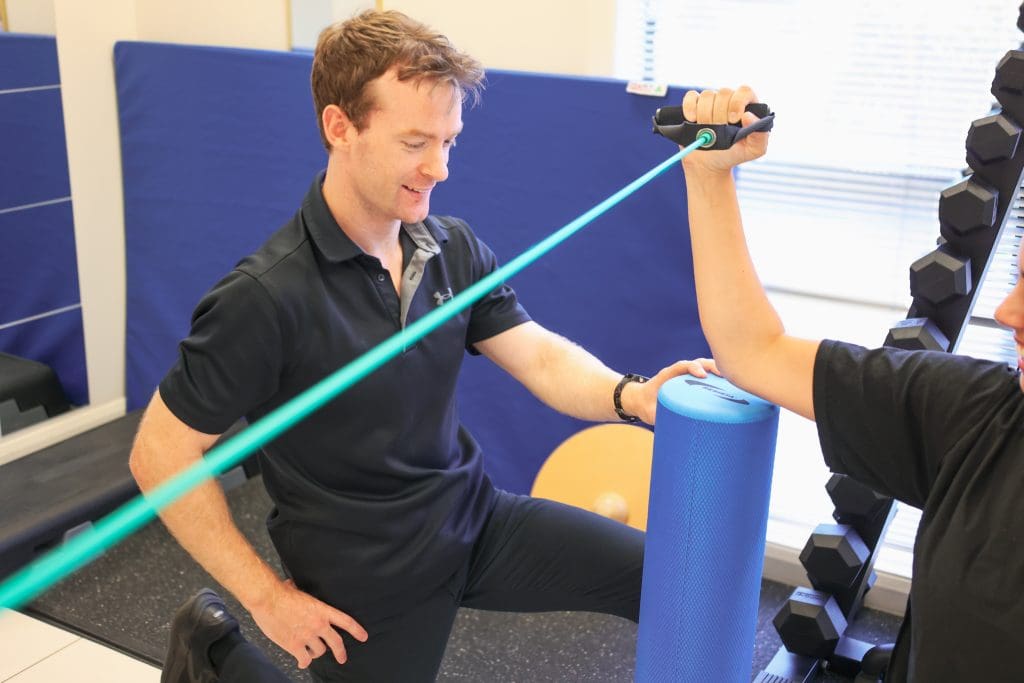
Your rotator cuff is four tendons that act almost like one continuous unit — think of it as a sleeve wrapped around your shoulder joint. A tear in one part of that sleeve doesn’t mean you can’t strengthen the rest. In fact, avoiding load altogether can weaken the rest of the cuff, making your shoulder less tolerant of load overall — which usually makes things worse, not better.
Workplace rotator cuff injuries — risk management and prevention
Rotator cuff injuries are one of the most common shoulder complaints we see in workers doing repetitive overhead tasks or manual handling — think tradies, warehouse and logistics staff, and anyone doing repetitive lifting or overhead work across North Queensland’s mining, construction, and transport/logistics industries. A few practical ways to reduce risk in the workplace:
- Job design – minimise unnecessary overhead reaching, use mechanical aids for heavy or awkward lifts, and rotate tasks to avoid prolonged repetitive strain.
- Early reporting – encourage workers to report niggles early rather than pushing through, so issues can be managed before they escalate.
- Workplace-based assessments – a targeted ergonomic assessment can pinpoint the specific task or workstation factors driving shoulder load.
- Graduated return to work – for workers recovering from a shoulder injury, a structured, graded return to duties reduces re-injury risk compared to an all-or-nothing return.
Take-home messages
- A “tear” on a scan doesn’t mean you’re broken — these findings are extremely common, even in people with no pain at all.
- Imaging alone doesn’t dictate treatment; your function and symptoms matter more than what the scan shows.
- Most rotator cuff tears can be managed conservatively with the right, progressive loading program.
- Surgery is one option among several — the right choice depends on your age, the tear itself, and your goals.
- If you’ve been told you have a rotator cuff tear and aren’t sure what it means for you, come see us — we’ll help you make sense of it and build a plan that fits your life.
Reference: Geary MB, Elfar JC. Rotator Cuff Tears in the Elderly Patients. Geriatr Orthop Surg Rehabil. 2015;6(3):220-224.