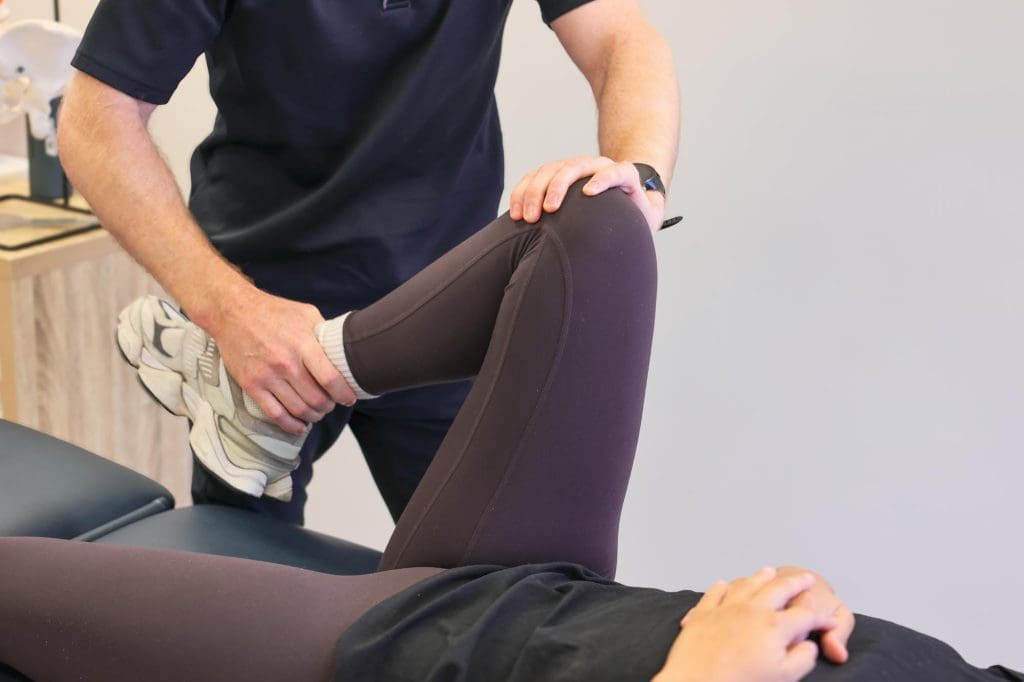
Hip Pain Stopping You at Work or Sport? You Could Have FAI
If you’re experiencing groin or hip pain — especially during long periods of sitting at a desk, after a run, or during change-of-direction sport — you may be dealing with a condition called femoroacetabular impingement (FAI).
At ErgoPhysio, our Townsville physiotherapy and occupational health clinic, we see FAI regularly in both active individuals and desk-based workers. The good news? With the right treatment plan, most people make a strong recovery without surgery.
What Is FAI (Femoroacetabular Impingement)?
FAI is a hip joint condition where abnormal contact occurs between the ball and socket of the hip, causing pain, stiffness, and reduced function. It is one of the most common causes of hip and groin pain in active adults aged 20–50.
There are two main structural types:
- CAM morphology — an abnormal shape of the femoral head (ball)
- Pincer morphology — excess coverage by the acetabulum (socket)
Many people have both.
Common Symptoms of FAI
You may have FAI if you experience:
- Pain at the front of the hip or groin
- Discomfort after prolonged sitting or desk work
- Pain during or after running, or sports involving twisting and cutting movements
- A stiff or restricted hip — particularly when bending forward
- Reduced strength around the hip, groin, or lower back
- Clicking or locking sensations in the hip
These symptoms are frequently aggravated by sustained sitting — making FAI particularly relevant for office workers, drivers, and anyone in a sedentary role here in Townsville.
How Is FAI Diagnosed?
Diagnosis of FAI requires three criteria to be met — a framework established by the internationally recognised Warwick Agreement:
- Symptoms consistent with FAI (hip/groin pain)
- Positive clinical tests performed by a physiotherapist
- Imaging findings confirming CAM or Pincer morphology on X-ray
If you’re unsure whether your hip pain fits this picture, the team at ErgoPhysio can assess you and coordinate imaging referrals where needed.
Treatment Options: Why Physiotherapy Comes First
Conservative management — led by physiotherapy — is the recommended first-line treatment for FAI. Surgery is reserved for those who do not respond to conservative care, or who have secondary complications such as labral (cartilage) tears.
The evidence comparing surgery to physiotherapy is more nuanced than many patients expect. A 2021 systematic review and meta-analysis published in Clinical Rehabilitation (Bastos et al.) found no statistically significant difference in disability outcomes between surgical and conservative treatment at six months or beyond. A separate systematic review and meta-analysis of five RCTs found that supervised physiotherapy programs focusing on active and core strengthening produced statistically significant improvements in functional outcomes — outperforming unsupervised, passive, and non-core-focused programs.
A 2022 systematic review in the Journal of Clinical Medicine (Anzillotti et al.) noted that while surgery may offer faster short-term gains in some patients, both arthroscopic treatment and physiotherapy demonstrated beneficial effects — and the best standard of care remains an open clinical question.
For most people with FAI, a well-structured physiotherapy program is not just a reasonable first step — it is strongly supported by the current evidence base.
How ErgoPhysio Treats FAI
At ErgoPhysio, our approach is accredited, collaborative, and evidence-based — the same principles that underpin all of our clinical and occupational health services.
1. Progressive Strengthening
Targeted strengthening — especially of the hip adductors (groin muscles) and core — is the cornerstone of FAI rehabilitation. Our physiotherapists design individualised, progressive programs suited to your work demands, sport, and lifestyle — and regularly used within our 6-week hip & knee program.
2. Manual Therapy
Hands-on treatment to the surrounding muscles and hip joint provides short-term pain relief and helps you engage more effectively with your strengthening program. The landmark FAIR randomised controlled trial validated this combined approach of manual therapy plus progressive exercise in structured FAI rehabilitation.
3. Education and Load Management
Understanding what aggravates your hip is critical. Common triggers include:
- Excessive sitting with the hip in a bent position
- High-impact activity
- Rapid change-of-direction movements
We help you manage these in the short-to-medium term so your hip can settle and rehabilitation can progress.
4. Objective Measurement — We Don’t Guess
We use a hand-held dynamometer to precisely measure hip adduction (groin) strength — one of the most commonly impaired areas in FAI. We also assess hip flexion range of movement to monitor joint irritability over time. Validated tools including the International Hip Outcome Tool (iHOT-33) and the Hip Outcome Score (HOS) can guide clinical decision-making throughout your recovery.
FAI and the Workplace: Where ErgoPhysio’s Occupational Health Services Make a Difference
ErgoPhysio is uniquely positioned to support both the clinical and workplace dimensions of FAI — something most physiotherapy clinics cannot offer under one roof.
FAI commonly affects workers in:
- Sedentary roles — prolonged desk sitting is a primary aggravator
- Manual handling roles — loaded hip flexion during lifting and carrying can flare symptoms
- Mining, construction, and transport — industries prominent across North Queensland
Our Occupational Health Services for FAI Include:
Ergonomic Workstation Assessments Our team assesses your workstation setup to reduce hip flexion load. Key adjustments include raising chair height, modifying desk and monitor position, and scheduling structured sit-to-stand breaks throughout the day.
Onsite Physiotherapy ErgoPhysio provides onsite physiotherapy services to Townsville businesses — allowing early intervention before a hip issue escalates into a WorkCover claim or significant time off work.
Ergonomic and Musculoskeletal Risk Assessments For employers managing workers with known hip conditions, our musculoskeletal risk assessments identify task and environmental risk factors and provide practical, documented recommendations.
Job Task Analysis / Job Dictionaries We produce detailed job task analyses to support WorkCover, return-to-work planning, and pre-employment screening for roles requiring hip loading — ensuring workers are matched safely to their duties.
Pre-Employment Functional Assessments Our pre-employment screening identifies individuals who may be at elevated risk of hip injury in physically demanding roles — helping employers make informed, evidence-based placement decisions.
Post-Operative Rehabilitation For those who do proceed to arthroscopic surgery, ErgoPhysio offers structured post-operative rehabilitation, consistent with the evidence-based protocols used in the FAIR trial.
Early occupational health intervention reduces time off work, supports WorkCover claims management, and prevents a short-term hip problem from becoming a long-term liability.
Why Choose ErgoPhysio Townsville?
- APA-accredited physiotherapists with expertise in hip and lower limb conditions
- Integrated occupational health and ergonomics services — rare in one clinic
- Evidence-based, measurement-driven rehabilitation underpinned by published research
- Specialists in WorkCover, return-to-work, and onsite injury prevention
- Conveniently located at 112 Bowen Road, Rosslea (inside Munoz Medical Centre), serving the Townsville CBD, Kirwan, Aitkenvale, and surrounds
- Direct communication with employers, insurers, and treating doctors
Book an Appointment at ErgoPhysio Today
Whether you’re a patient dealing with hip or groin pain, an employer managing a workplace injury, or a WorkCover coordinator looking for a trusted allied health provider in Townsville — ErgoPhysio is here to help.
📞 Call: (07) 4758 0500 | 0484 250 746
📧 Email: info@ergophysionq.com.au
📍 Clinic: 112 Bowen Road, Rosslea QLD 4812 (inside Munoz Medical Centre)
🌐 Website: ergophysionq.com.au
📅 Book Physiotherapy Online
For onsite, injury prevention, or WorkCover referrals, use the enquiry form at ergophysionq.com.au/contact.
Follow ErgoPhysio:
Facebook | Instagram
References
The clinical claims in this article are supported by peer-reviewed research. For a full list of relevant studies on femoroacetabular impingement and physiotherapy, see the Google Scholar search below:
🔗 FAI & Physiotherapy — Google Scholar Research Library
Key studies informing this article include:
- Bastos RM et al. (2021). Surgery is no more effective than conservative treatment for femoroacetabular impingement syndrome: systematic review and meta-analysis of randomized controlled trials. Clinical Rehabilitation, 35(3), 332–341.
- Kemp JL et al. (2018). The Physiotherapy for Femoroacetabular Impingement Rehabilitation STudy (physioFIRST): A Pilot Randomized Controlled Trial. Journal of Orthopaedic & Sports Physical Therapy.
- Shanmugaraj A et al. (2019). Physiotherapy as an Initial Treatment Option for Femoroacetabular Impingement: A Systematic Review of the Literature and Meta-analysis of 5 Randomized Controlled Trials. PubMed (PMID: 31774704).
- Takla A & O’Donnell J et al. (2017). Efficacy of adding a physiotherapy rehabilitation programme to arthroscopic management of femoroacetabular impingement syndrome: a randomised controlled trial (FAIR). British Journal of Sports Medicine (PMID: 28645960).
- Anzillotti G et al. (2022). Conservative vs. Surgical Management for Femoro-Acetabular Impingement: A Systematic Review of Clinical Evidence. Journal of Clinical Medicine, 11(19), 5852.